 By
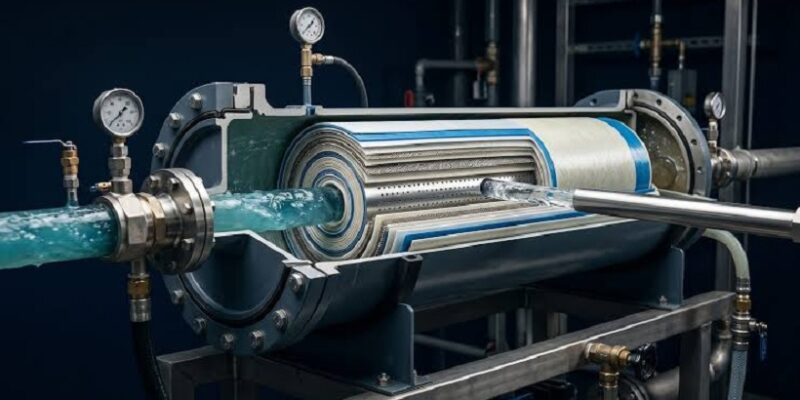
By Walk into enough plant rooms and a pattern emerges. A reverse osmosis plant commissioned four years ago is producing perhaps 60% of its rated output, its membranes have been replaced twice, and nobody on site can say what the recovery rate is. The technology is rarely at fault. RO is a mature process that reliably removes 97 to 99% of dissolved salts, and element prices have fallen in real terms for decades. When an installation disappoints, the cause almost always traces back to a decision taken long before commissioning.
Start with the water, not the flow rate
The commonest error is treating RO as a commodity purchase defined by litres per hour. Feedwater chemistry drives everything downstream, and UK supplies vary enormously because the geology does. Water drawn from the chalk aquifers beneath London, Kent and East Anglia routinely exceeds 300 mg/l as calcium carbonate, with some zones above 400. Parts of Scotland and Wales sit below 60 mg/l. Roughly 60% of the country is classed as hard or very hard. A design that performs well in Merseyside can scale within weeks in Cambridge.
Hardness is only the headline. Silica, iron, alkalinity and organic carbon all shape the pre-treatment train. Ask your wholesaler for twelve months of zonal data rather than designing from a single sample, since blended and borehole supplies shift seasonally.
Pre-treatment decides membrane life
Membranes fail through scaling, fouling or oxidation, and all three are pre-treatment problems.
Oxidation is the least forgiving because it cannot be reversed. Polyamide membranes lose salt rejection after roughly 1,000 ppm-hours of free chlorine exposure, and manufacturers advise keeping continuous exposure below 0.1 ppm. A typical mains residual of 0.5 mg/l consumes that budget in about 2,000 operating hours, under three months of continuous running. An exhausted carbon filter, or a bisulphite dosing pump that has been airlocked for a fortnight, can write off a full set of elements before anyone notices the conductivity drift.
Scaling control means choosing between softening and antiscalant dosing. Softening permits higher recovery but adds salt handling and regeneration effluent. Antiscalant is simpler and cheaper to install, provided the dose is matched to the actual chemistry and revisited when that chemistry changes.
Recovery is a rising running cost
Recovery, meaning permeate divided by feed, gets glossed over at a tender stage and hurts over a ten-year life. Single-pass mains systems typically run between 50 and 75%.
Take a plant producing 5 m³/h, running 16 hours a day for 250 days a year. At 70% recovery it sends roughly 8,570 m³ to drain annually. At 80%, that falls to 5,000 m³. With combined business water and wastewater charges now broadly £2.50 to £3.50 per cubic metre, those ten points are worth around £10,000 a year. Ofwat’s PR24 settlement approved £104 billion of investment by 2030, so charges will keep climbing. Reject water belongs in the business case, not the footnotes.
Monitor trends, not alarms
Most sites log feed pressure and permeate conductivity and little else, which cannot distinguish a genuine fault from normal seasonal behaviour. A 4°C drop in feed temperature reduces permeate flow by about 10% with no fouling whatsoever.
Normalising performance against the commissioning baseline solves that. Manufacturer guidance converges on cleaning when normalised permeate flow drops 10%, salt passage rises 5 to 10%, or stage differential pressure rises 15%. A properly maintained industrial element should give three to seven years of service. Sites replacing membranes every eighteen months have a pre-treatment or monitoring problem.
Choosing a supplier
The differences that matter are rarely visible on a datasheet. When comparing reverse osmosis companies, press on the questions that determine cost of ownership rather than headline capacity. Will they carry out a full water analysis before quoting? What recovery are they assuming, and on what basis? Are spares for that model held in the UK, and does the service contract include data trending or just a filter change and a signature?
The bottom line
Plants that still hit their design figures in year five are the ones where somebody insisted on proper feedwater analysis, specified pre-treatment for the water actually arriving on site, and set up monitoring that can tell a cold morning from a fouled membrane. None of this is exotic engineering, but with water charges climbing through to 2030, the gap between a well specified system and a poorly specified one widens every year.